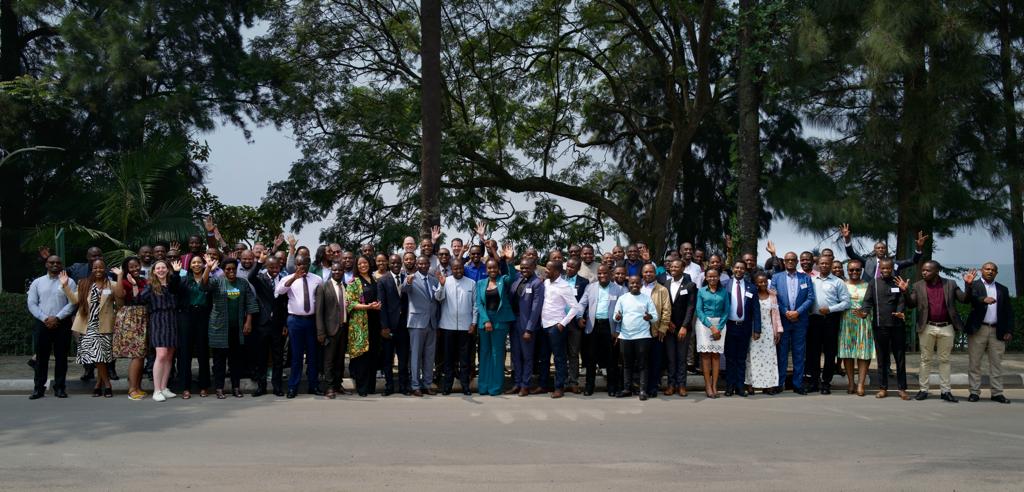
Waste Management Project
- Details
- Parent Category: topnews
Project Synopsis:
African cities, towns and shopping centers are growing rapidly, however, hygiene and sanitation is questionable whereby people’s health is affected due to the poor collection, treatment, transportation, storage, and eventual disposal of waste. The prevailing increase in the level of urbanization in Africa is expected to continue in the future.
RDIS organization is therefore currently implementing a “Waste Management for Environmental Safeguard” project in Rwanda. The beneficiaries of the project are Church’s training centers, guest houses, schools and health centers. Special training is given to managers and personnel of these institutions and people, especially the youth, who are likely to influence others with knowledge and skills about waste management. Special waste bins and policies are distributed to these institutions.
See also:
- RDIS Organisation participation on World’s Environment Day 2018 to demonstrate its initiatives to fight Plastic Pollution
- RDIS Organisation is taking part in the World Environment Day on 5th June 2018 by facilitating a workshop and some actions to #BeatPlasticPollution in Butare diocese.
- Photoalbum: RDIS Actions on World's Environment Day 2018 -- BeatPlasticPollution
Please visit us or call us for more information!
Field visit by RDIS staff members in Cyangugu diocese, in January 2018
- Details
- Parent Category: topnews
From 24th to 26th January 2018, two senior staff members of RDIS went for a field visit in the area of the Anglican Church of Rwanda, Cyangugu diocese. As one can see in the few pictures below, all ongoing projects in this area are running well thanks to the good work of local RDIS staff members, stakeholders and the excellent leadership of the diocese.
1. Visit to the tree nursery beds which are located in Rusizi district:
Since many years ago RDIS is collaborating with government leadership especially at local levels (District, Sectors, Cells and Villages) in establishing, running and managing tree nurseries, which reach nearly half of the population of Rwanda from Gitarama (RDIS headquarter) to Cyangugu, i.e. the wide area of Southern and Western Provinces. This project is in line with the mission of RDIS organisation of safeguarding the environment and increasing production for sustainable and holistic development of the communities.
The tree nursery project produces tree seedlings, which are distributed freely to community members and institutions in the area. This successful project is implemented by RDIS organisation with support from Rwanda Aid.
By the end of December 2017 the project had distributed and aided to plant 200,000 tree seedlings for fruit and agro-forestry. Each tree nursery bed had 25,000 seedlings for agro-forestry, i.e. forestry and fruit trees.
The field visit was a good opportunity to meet with the sponsor of Rwandan Aid, Ms Alison Wright <
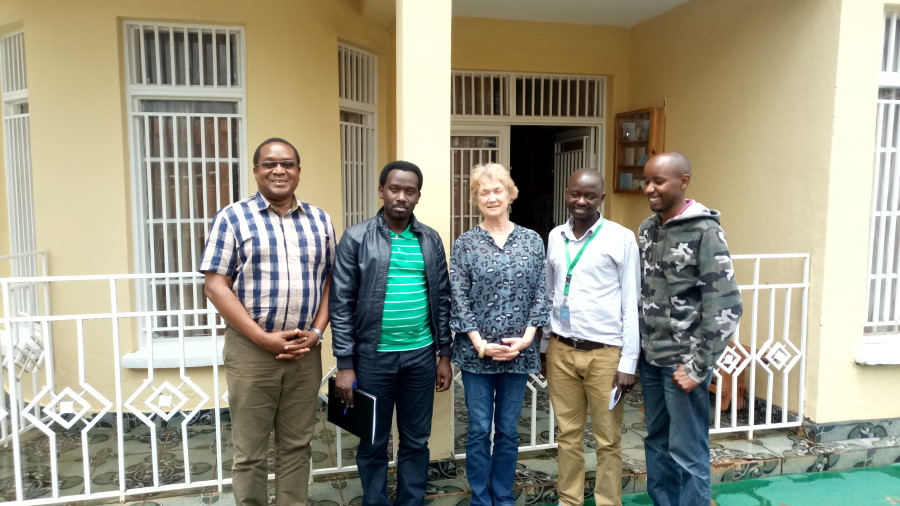
A group picture with Ms Alison Wright and some staff members of Rwanda Aid
Accomplishments and Call for Support 2017
- Details
- Parent Category: topnews
Dear Friends/Colleagues/Partners/Collaborators,
I cannot thank you enough for the work and accomplishments and achievements we got this year. Thank you all for your contributions!
In this year, we thought it would be ideal to share with you some of our accomplishments by this means - email and website. But more importantly, knowing that we are getting close to the end of the year, I would like to take this opportunity to wish you and your families a Merry Christmas and a prosperous New Year!
We have achieved a great deal despite of some challenges.
1. CCER - Improved Cook Stoves project:
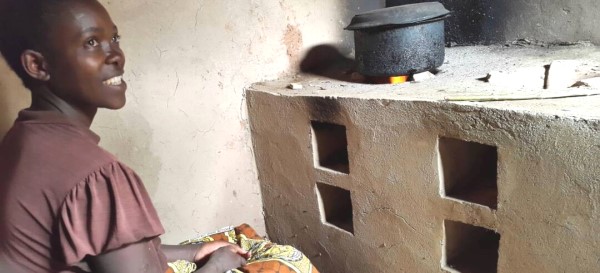
Among the major issues that challenge the environment in Rwanda is the wide use of open firewood stoves for cooking and for boiling drinking water. Similarly, the hunting, cutting, fetching and carrying of the tree logs and branches by man primarily living in rural communities have caused increasing deforestation despite the RDIS’s forestation and tree planting efforts. While the entire process is useful to enable households to have food on table, RDIS decided to come up with a project that would enable the local communities to continue using firewood for cooking in a sustainable and ecologically friendly way. This means we had to find an innovative solution of reducing the problem while promoting peoples welfare and standards of living. The only way to go was therefore to initiate Climate Change mitigation projects. Hence the planning and implementation of this project under the name: Carbon Emission Reduction for Self-sustainable Environmental Care Project (CCER).
Empowering Communities: A Journey Through RDIS's Sustainable Development Projects
- Details
For about three decades, the Rural Development Interdiocesan Service (RDIS) has been at the forefront of sustainable and holistic development, successfully implementing a multitude of interventions aimed at poverty eradication and environmental protection. Our approach is rooted in community engagement, where we mobilize villagers to take an active role in their development journey.
Through capacity building, training, and practical support, we address key areas that are pivotal to the growth and prosperity of the communities we serve. These areas include modern agriculture, environmental protection, income generation initiatives, water and sanitation, and the establishment of savings and credit cooperatives.
We invite you to explore our ongoing and past projects, each is a testament to our commitment to fostering sustainable development and empowering communities. Discover how RDIS is making a difference and join us in our mission to create a more sustainable and equitable world.
RDIS's Annual Narrative Report, April 2018 to March 2019
- Details
Annual Narrative Report April 2018 to March 2019
This report contains planned activities for each project, progress made, geographical areas, indicators, output and outcomes where possible. Also, it gives some success stories/testimonies highlighting the utility of the intervention at the household and community level.
Summary of activities April to September 2018
The report summarizes practical work carried out on the field from April to September 2018, strategic meetings with existing and new partners, Participation in clean cooking investment forum in Kigali.
UEM Volunteer Linus Kühnhold from Germany, 2023/2024
- Details
- Parent Category: projects

Greetings!
My name is Linus Kühnhold, a 19-year-old from Germany who served as a volunteer for RDIS from August 2023 to August 2024. This opportunity has taken me to Rwanda, where I've been immersed in various projects and involved in meetings.
During my time in RDIS, I delved into projects, witnessing how initiatives work. Among them improved cook stoves, ceramic water filters, solar panels, climate smart agriculture, tree nurseries, and construction of houses. It has been inspiring to see how these projects positively impact people's lives. When not working on field with coordinators, I assisted at my mentor Jonas's school or engage in meetings in Muhanga in the RDIS headquarter.
I am immensely thankful to the United Evangelical Mission (UEM), the Anglican Church and RDIS for this enriching year. It has not only strengthened me personally but also broadened my understanding of work in Non-Governmental Organisation´s like RDIS and in a different country.
Thank you.
International Volunteer Experience at RDIS - 2022/23
- Details
- Parent Category: projects
The following reflection was shared by an international volunteer who served at RDIS from October 2022 until August 2023. At the volunteer’s request and in respect of personal privacy, the name and photo of the volunteer remain anonymous.
“I was honoured to serve as a volunteer at RDIS from October 2022 until August 2023.
I was sent by the United Evangelical Mission (UEM), a long-term partner of RDIS and the four dioceses of the Anglican Church of Rwanda: Butare, Cyangugu, Kigeme, and Shyogwe. UEM organises several volunteer and exchange programs. Supported by Engagement Global, these programs encourage young people to engage with different social and cultural backgrounds and to broaden their perspectives through international experience. I was especially grateful to be among the first volunteers to participate again after the global Covid-19 pandemic.
My daily activities mainly involved office and administrative tasks, where I supported colleagues in their responsibilities and ongoing work.
I remain deeply grateful for the opportunity RDIS gave me and for the many experiences through which I learned more about the organisation’s work and the socio-economic context in which it operates.
These experiences strongly influenced both my academic journey and my personal development. The staff of RDIS works every day to positively impact the lives of their beneficiaries and during my time there, they also had a meaningful impact on mine.
Thank you, RDIS, for this enriching and unforgettable year.”
International volunteer service invites young people between the ages of 18 and 28 to spend a year contributing to projects in another country. Working together, cultural exchange, and learning from one another in everyday life are central aspects of the volunteer experience.
The Rural Development Interdiocesan Service (RDIS) in Rwanda periodically offers placements through the North-South volunteer program. This forms part of the United Evangelical Mission’s (UEM) volunteer service and the broader weltwärts program.
Page 12 of 13
Our Sponsors and Partners
RDIS collaborates with a diverse network of sponsors and partners who share its commitment to development, innovation, and community impact. These valued allies provide strategic support, resources, and expertise, enabling RDIS to implement sustainable projects, enhance service delivery, and drive positive change across Rwanda and beyond