- Details
Case study 1: Curusi Local Church
CURUSI chapel is one the local church which have been mobilized for holistic development. It is a local church of Anglican Church of Rwanda, Gikonko Parish, Butare Diocese, located in Curusi Village, Cyiri Cell, Gikonko Sector of Gisagara District. The mobilization in this local church started towards the end of March 2016. After being mobilized for holistic transformation, Christians were awaken and started thinking of different activities that can help them through the process of transformation. In the one year, local church members in Curusi have started 3 transformative groups and 2 of them (“Abahuje umutima” and “Ingabo z’Umwami”) have so far accumulated savings totaling 460,000 Rwanda Francs. The first group composed of 35 members have saved 200,000 RWF and are planning to buy domestic (Pigs) for each member. Another transformative group constituted of Sunday school children, have saved money and managed to buy rabbit for each child among 90 children. During our last visit on March 25, 2017, local church members shared with us testimonies, and we learnt that 4 members had already got cows as a result of lessons acquired in CCMP; 10 members have got pigs, 5 have purchased chickens, 7 have purchased rabbits and 5 have purchased goats.
During field visit at Curusi local church, church members have shared their integral change progress stories and 3 people’s stories were recorded. These are:
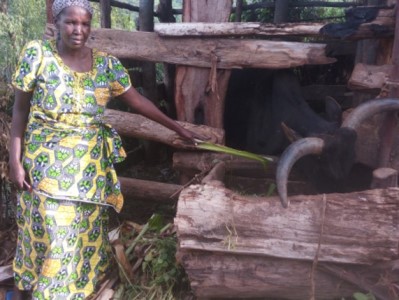
# MUKAHIRWA Lydia, a 56 years old woman living in Curusi Village, Cyiri Cell, Gikonko Sector of Gisagara District. After being mobilized through CCMP; she became member of transformative group and from the savings the group has, she got a small loan worth RWF 30,000 that she is using to carry out small business of buying and reselling domestic animals [goats] and from this business she can help the family of 6 members and pay school fees for her 4 children. From her business, she has now managed to buy a cow as shown in the picture below.
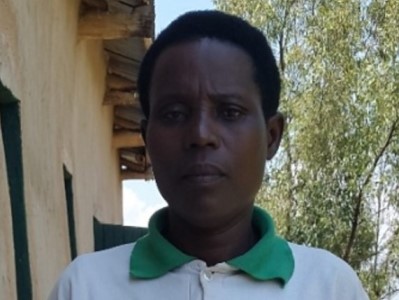
# Uwizeyimana Juliana is a 46 years old woman. She lives in Curusi Village, Cyiri Cell, Gikonko Sector of Gisagara District. After CCMP training, she joined a transformative group that carries out saving and credit as well. From the savings, she got a loan worth RWF 25,000 to run small business. She makes soft drink prepared from sorghum flour and can generate income. She has bought a pig from her business and can provide family survival needs. She affirms to pay school fees for her children and state that she can pay back the loan and get a new one whenever needed. She is a window of 5 orphans, she has many problems, through the problems resolution, she told us the source of finance is to make soft drink of sorghum and to follow the lessons from CCMP training. After one year UWIZEYIMANA increased the activities.
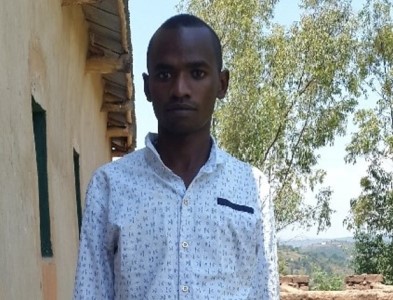
# NUWAYO Placide is a 23 years old young man who completed his secondary school education in 2015. He lives in Murambi Village, Cyiri Cell, Gikonko Sector of Gisagara District. After being mobilized for holistic development, he realized that he should not waste his time waiting for seeking for a job. He started small business of shop keeping, farming and animal rearing. He can now attest that he is able to respond to basic living needs with which he could not cater for if he had not changed his thinking and mindset.
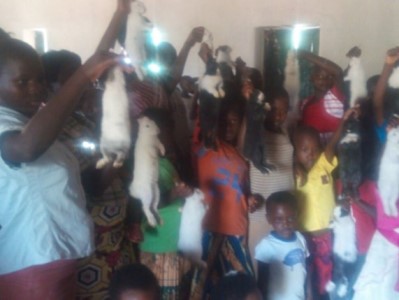
# Photo above show Sunday school children when they were given rabbits for rearing from their own savings.
Case studies and stories of change in CCT Programme
- Case study 1: Curusi Local Church
- Case study 2: GAHABWA Local church
- Case study 3: RWATANO Local church
- Case study 4: Kinkanga Local Church
- Details
Case study 2: GAHABWA Local church
Gahabwa chapel is one local church which have been trained and mobilized for holistic development. It is a local church of Anglican church of Rwanda, Gikonko Parish, Butare Diocese, located in Gahabwa village, Gikonko cell, Gikonko sector of GISAGARA district. After the training of CCMP about holistic transformation, the church members of Gahabwa were awaken and started thinking of different activities that can help them through the process of transformation. From the date of training up to date Gahabwa church members started transformative group which called TERIMBERE MUHINZI W’URUTOKI as we see in the name of transformative group, their target is to improve banana plantation and using modern farming techniques.
Total of group members is 40. Other activities in group is saving and credit up to day each members of group have one domestic animals from the transformative group because of savings and credit. Those domestic animals are pigs and goats. Because of training the members of group started to imitate the farming techniques in their home and to improve them self.
During field visit at Gahabwa chapel some transformative group members have shared their change stories in their home.
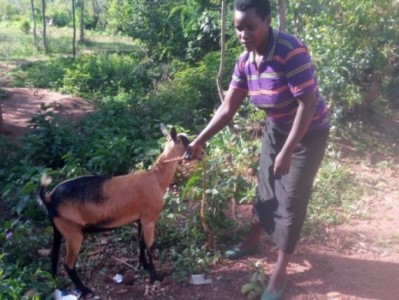
NYIRAMINANI Esperance is a 30 years old women living in Gahabwa village Gikonko Cell, Gikonko Sector, Gisagara District. After being mobilized through CCMP, she became member of transformative group, and after being in transformative group, she got a goat as one of transformative group members. Esperance told us this goats help her to develop them self through modern agriculture of beans, banana and others food crops by using fertilizers ,and she told us she started other small business by using small loans from transformative group of saving and credit of Gahabwa.
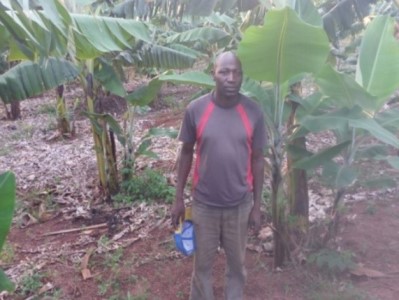
NYANDWI J. Damascene is 34 years old man. He lives in Gahabwa Village, Gikonko Cell, Gikonko Sector of Gisagara District. After being mobilized and trained for holistic development, he realized that he should not waste his time , he started to cultivate the banana plantation by using modern techniques and he started to regular participate in the transformative group and started to apply group activities at his home. NYANDWI got a loan in the transformative group and he started to construct a house; currently, NYANDWI has his own house, 2 cows and 1 goat. All those animals and house are from the loans of transformative group of Gahabwa.
Case studies and stories of change in CCT Programme
- Case study 1: Curusi Local Church
- Case study 2: GAHABWA Local church
- Case study 3: RWATANO Local church
- Case study 4: Kinkanga Local Church
- Details
Case study 3: RWATANO Local church
RWATANO local church is one local church which have been trained and mobilized for holistic development. It is a local church of Pentecostal church of RWANDA (ADEPR), Gikonko Parish, located in Rwatano village, Bukinanyana cell, Musha sector of GISAGARA district. After the training of CCMP about holistic transformation, the church members of RWATANO were awaken and started thinking of different activities that can help them through the process of transformation. From the date of training up to date RWATANO church members started transformative group which called TUZAMURANE, this group save 600F/month to each members their target is to improve them self through the creation of transformative group of saving and credit by providing loans to the members of group and using modern farming techniques in agriculture in order to attain sustainable development in Rwatano village. Total of group members is 18. After training Rwatano local church started thinking of different activities that can help them. Because of training the members of group started to imitate the farming techniques in their home and to improve them self.
When you visit RWATANO local church positive change attract you, because after mobilizing and training of CCMP the church of RWATANO improved through construction and around of church there are modern plantation of banana.
Case studies and stories of change in CCT Programme
- Case study 1: Curusi Local Church
- Case study 2: GAHABWA Local church
- Case study 3: RWATANO Local church
- Case study 4: Kinkanga Local Church
- Details
Case study 4: Kinkanga Local Church
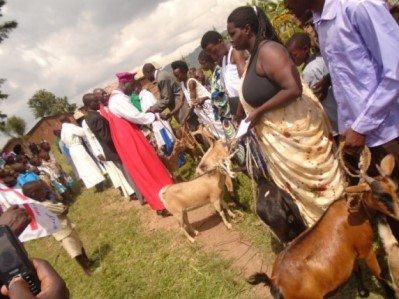
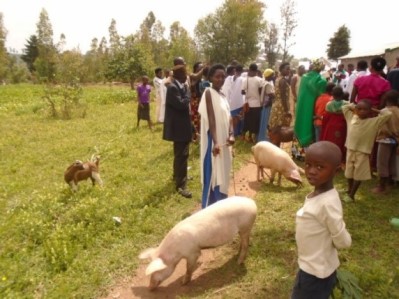
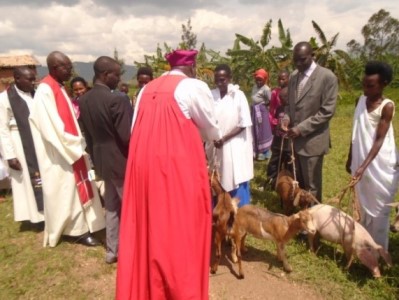
Church and community mobilization in Kinkanga Parish started in the year March 2013-February 2014. After a series of mobilization session and training of the committed, a transformative group was formed composed of 42 members including 13 males and 29 females. The group’s name is Duterimbere (Literally translation is “Let us develop ourselves”). An exciting progress has taken place in Kinkanga where so far after accumulating savings, they have resolved to provide each household with domestic animal, basically to enable them get manure to fertilize their limited lands for cultivation. They have offered each family with one goat and one pig. Every time in a year, they organize a celebration day where distribution of domestic animals is made in the presence of church leaders.
Photos below were taken on December 20th, 2015 when the celebration was taking place in the presence of the Bishop of EAR Butare Diocese. Testimonies from beneficiaries prove that currently, every household can get balanced diet at least twice a day whereas before only one household out of three managed to get food twice a day.
Case studies and stories of change in CCT Programme
- Case study 1: Curusi Local Church
- Case study 2: GAHABWA Local church
- Case study 3: RWATANO Local church
- Case study 4: Kinkanga Local Church
- Details
Empowerment of single mothers and under high risk girls project funded by Rwanda Governance Board and implememnted by Rural Development Inter-Diocesan Service benefiting districts: Kamonyi, Nyanza And Nyamagabe.
Hier: Success stories documented during the project monitoring as of 23rd and 24th may 2016
Success story 1: She will reach her dream
At the age of 19 years, Ayikamiye Telephonia dropped out of her secondary school because of lack of adequate scholastic materials; she joined a vocational school under WDA program in Rwanda where she acquired skills in hair dressing. After the 6 months of intensive training, Ayinkamiye started a saloon using the little required capital that she got from her parents.
In a busy center of Nyarubaka, she saw her business growing day and night. Her hope of a better future kept on going. As days came to pass, a very smart boy from the district of gisenyi opened mens saloon next to her door. As a welcoming neighbor, Ayinkamiye welcomed the boy and showed him all corners of the busy center.
Friendship between the two opposite sex kept on growing, and in the long run the two fell in romantic love. The girl was impregnated after 2 months of the intimacy relationship.
The news went up to the parents of the two. And family talks started where the boy accepted the responsibility of taking care for the girl and the children until birth. But as things went on the colors turn red, the boy discovered that he could not afford the responsibility, he finally run away from the village leaving the girl to depend on her biological parents.
Ayinkamiye narrates that it wasnt easy for her parents to take care of her during this critical time where she needed a lot of care from either the father of the children or any other passionate person. She was bullied, abused, beaten and most often by her own parents until she left to his uncle at six months. At her uncles place, she had some peace and its her uncle that helped her parents understand that Ayikamiye wanted more parental care and help than being neglected.
Nine months after giving birth, in the early morning hours, Ayikamiye who was washing her face had an announcement by the village announcer that a certain NGO in this case RDIS was inviting single mothers and out of school girls for a meeting. She did arrange to attend the meeting.
In this meeting, she was selected as one of the single mothers who would undertake different trainings both theoretical and practical. She was so much impressed by the practical training on hand craft she is under taking. She believes that if her salon skills are complemented by the hand craft skills she will be able to provide all the basic needs to herself and children but also to her parents as a thank you for what they did to her during the tuff times.
Despite the life challenges and difficulties she has gone through, and with the little she is anticipating in her future business (lack of raw materials, inadequate market, and sickness), Ayikamiye is still optimistic that her future life will be the same to her childish dreams. With all these opportunities that I am exposed to, I will remain focused to what I wanted to be since childhood, all I want is a better future Ayikamiye said.
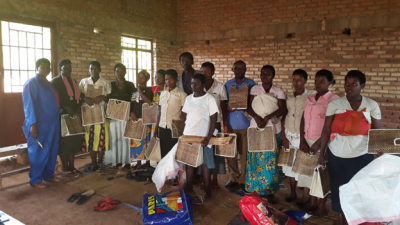
Training beneficiaries in group photo. From right Ayinkamiye in white t-shirt and black skirt while Nyirarukundo Noami is 2nd from right. First from Left (Blue Oval) is the teacher trainer.
Success story 2: Tough times require tough heart
Be tough too when the situation becomes tough and be rough when life is becoming rough Nyirarukundo Naomi a girl from a family of 5 children starts her story emphasizing the quote and with a smile on her face. Naomi who is 18 years old is the first born of the 4 girls and 1 boy. Because of the family poverty, Naomi could not go beyond senior three despite the government policy of free and subsidized education because of other essentials that may require some money.
She walks a distance of 5 kilometers every day and covers about 20 kilometers every week for the hand craft skills training she is taking. For the last one month, she has been able to make shopping basket from banana leaves and she expects to learn more.
Previously, she would do yellow banana selling alongside the roads in every evening, and she hopes that her small business skills will expand given the trainings she is receiving from RDIS. She dreams becoming a strong business woman.
Success story 3: RGB and RDIS efforts restoring vulnerable girls hopes
Tuesday early morning, I set off with my collogues from Muhanga head office to Nyamagabe district to visit the single mothers and under high risk girls project that is funded by RGB.
Few minutes to noon, we reach Mbazi sector. In the center is the training room hired for the 12 girls who RDIS is training on sewing and tailoring. Surprisingly all these girls speak good English and some French. They have reached at least senior three of the secondary school.
With 5 of the 12 having children of 3-2 years, and the remaining 7 having no children, they still live happily and together despite the children of the five crying, playing with the sewing machines and also making noise during class hours. Claudine said Giving birth by any of our classmates here may is bad luck, it was no intended and it can happen to any of us too she said a child is a blessing and these children you see here have no sin on them . Her words shows that many people are changing their thinking and perception towards the single mothers in our traditional leaving.
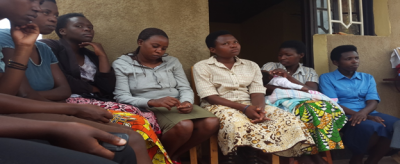
Part of Beneficiaries (Class) listening to visitors
Constance the class leader completed her advanced level of education. She did History, English and Geography as a combination. She completed in 2014 and she could not get the government bursary for university education despite having scored well because of many students who had scored better than her. She had lost hope of getting a job as her education background can only en able her seek a job than create her own. Today she narrates that with courses that she has covered in this training like: sewing machine installation, moving the wheel and fixing it, cutting and merging together the cloth, making pants, vests and the more she expects, she will make her own toiling workshop instead of moving from office to office.
Nikuze Claudine from a family of 9 children, 4 boys and 5 girls wanted to become engineer- architecture. She lost her dream when she completed her primary education and couldnt proceed to secondary school. Her father could not fully support her for further vocational studies the only alternative she had if her future was to be better, she half way did building and construction, hotel management and toiling courses this left her in a paradox. Today she is impressed by the second chance of doing the toiling and she believes that its an opportunity to excel in toiling given that for all the courses she did not complete, only toiling has repeated itself.
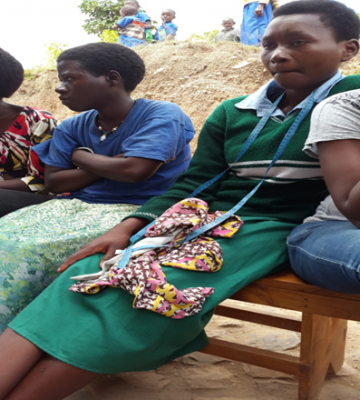
Seated in between others, she is putting on her previous school uniform. Very attentive as if she is a candidate waiting for national examination papers. When asked about her attire, she said that her school uniform makes her unique to other girls who she may meet on her way to and from the training center. When someone meets me on the way and I am in school uniform she/he will respect me. You cannot joke with a school girl, they will arrest you when you temper with her to her, school uniform is a preventive measure from men and any other destructor.
MurangijeImana is another girl in this group who you will love to see when you visit this project. She is a bit shy and ca not hold direct eye contact with you for long. She loves toiling and hand craft, but she had no opportunity until the latter. MurangijeImana had not reported in the first group of girls who came on the first day after hearing the village announcement inviting single mothers and under high risk girls for a meeting, in the eve of the evening when she was going to fetch water, she meet a group of girls who were coming from the meeting. They told her that none of the group members had been selected because they didnt have the basic requirements couldnt read and write. She asked the group members if the registration was under way and indeed she reported the next day for registration and she was enrolled. I was accepted and registered on the second day, to me that is the beginning of new life she said.
Though she has no child, she knows that she is not unique to such circumstances and she can at any time if not careful be pregnant. They are very many careless, liars and un serious men outside here, they speak nice words to you and when you believe them you suffer alone, we as girls we have to be sharp she said
With the endless expression of the best they have acquired and with high level of concern to excel in future given the knowledge and skills acquired through RDIS trainings, the project beneficiaries believes that they will make it. The sky is neither the limit one beneficiary said
Beneficiaries leaving their seats after our departure. At the back of the t-shirt of middle beneficiary is "better tomorrow is our goal"
Provided RDIS continues the women empowerment, gender based violence, and gender equality advocacy with emphasize in micro-finance service for rural entrepnuership, the communities are likely to experience a dynamic life transformation which will lead to social and economical well being.
In spite the normal constraints which many project proponents experience (differences in beneficiaries level of commitment, inadequate resources, etc) The project is very significant and relevant to the community needs and is community driven project.
The writer is Emmanuel kwiizera
RDIS Worker
- Details
Introduction
Rural Development Inter- Diocesan Service (RDIS) has observed over the years through community entry and need assessment activities dealing with orphans and vulnerable children that most homes are run by women most of whom are single and teenage mothers.
These we are willing to have trained and empowered to improve on the livelihood of their respective families. Most of the girls we interviewed assured us that they were able to engage in income generating activities, sales of used clothes, tailoring, hair dressing, knitting and other related businesses since most responsibilities in their homes depended on them. Women have become an increasing icon of social and economic development. However, five stumbling blocks have been identified to be increasing the vulnerability.
- Details
Church and Community Transformation (CCT) is an approach that is used by some development agents to mobilize church and community members in the fight against abject poverty using the resources at their disposal. The programme intends to help churches and communities to achieve material, spiritual, social and economic transformation through mindset change, change in the way of thinking and doing things.
This programme has been introduced in Rwanda by Tearfund UK through its partners with the objective of mobilizing church and community members for holistic and sustainable development.
It is recently in 2014 that Tearfund resolved to implement CCT in selected Districts focusing on the vulnerability levels. Consequently, RDIS was assigned to implement this programme in Gisagara District in order to concentrate efforts in one area to achieve tangible results. The programme is currently being implemented in 22 local churches in Gisagara District out of which 6 are Pentecostal local churches and 16 are Anglican Church of Rwanda local Churches. These local churches are located in 6 Sectors of Gisagara District namely: Gikonko, Musha, Ndora, Muganza, Kansi and Kibirizi.
The programme is currently serving a total number of 7,040 beneficiaries including 1,760 direct beneficiaries and 5,280 indirect beneficiaries.
Steps through which Church and Community Transformation activities are undertaken
- Selection of target local churches and communities
- Conducting baseline survey
- Envisioning local Church and community leaders
- Local Church and Community leaders Seminar/training on CCT
- Local church and community envisioning
- Training of the committed
- Selection and training of Facilitators
- Formation of Self-Help Groups
- Training selected community members on important themes such as:
- Modern Farming techniques (Theory and Practical)
- Saving and Credit for entrepreneurship
- Water, Hygiene and Sanitation
- Accompanying and encouraging Self-Help Groups in small income generating activities and programs intended to transform spiritual, social and economic conditions of beneficiaries
- Monitoring and Follow up and Evaluation
Case studies and stories of change in CCT Programme
- Case study 1: Curusi Local Church
- Case study 2: GAHABWA Local church
- Case study 3: RWATANO Local church
- Case study 4: Kinkanga Local Church
♥ GO BACK TO THE OVERVIEW.
Subcategories
Our Sponsors and Partners
RDIS collaborates with a diverse network of sponsors and partners who share its commitment to development, innovation, and community impact. These valued allies provide strategic support, resources, and expertise, enabling RDIS to implement sustainable projects, enhance service delivery, and drive positive change across Rwanda and beyond